
Monetizable AI prompts are simply clever instructions you give to tools like ChatGPT to produce content or ideas that can earn you money. You’ve come to the correct place if you’ve been wondering how to use ChatGPT to earn money. In fact, you may produce digital goods, marketing materials, and services that generate revenue just by answering the appropriate prompts. These money-making AI prompts work for freelancers, digital marketers, and creators alike. The better your prompt, the better the output, which means more value you can offer and monetize.
Below, we’ve organized 50 actionable AI prompt ideas into categories (Freelance Writing, Social Media Marketing, Digital Products, Business Consulting, and YouTube Content).
Each prompt is designed to be professional yet easy to use, you may input it into ChatGPT (or another AI) and start earning money right away. Let’s get started!
Freelance Writing Prompts (Earn as a Writer)
AI can help freelance writers create content more quickly for their own projects or for clients. Use these ChatGPT prompts to increase your income by in writing cover blog posts, copywriting, and other in-demand writing tasks.
SEO Blog Article: “Write a 1,500-word blog post for [target audience] that is optimized for search engines on [topic].” Include relevant keywords (like [keyword]) and a natural call-to-action related to [product/service] at the end.”
Make short blog post drafts using this prompt so you can sell them to customers or post them on a blog website that makes money (with affiliate links or ads).
Affiliate Product Review: “Write a detailed review comparing [Product A] and [Product B]. Emphasize the benefits, drawbacks, and which is better for [particular user]. Encourage readers to click on the affiliate link of their choice by providing an honest recommendation.”
Excellent for creating blog posts that generate revenue via affiliate marketing.
Product Description for E-commerce: “Generate an engaging product description for a [product name]. Highlight its top features and benefits to [target customer], and include 5 bullet points of key specs. End with a subtle call-to-action to buy now.”
Helpful for independent copywriters creating e-commerce or Amazon listings that increase sales.
Landing Page Copy: “Draft effective landing page copy for a [service/product]. Start with a catchy headline that addresses [customer pain point], then a short story or feedback, and finally, a button that reads “[Get Started Now]” as a clear call to action.”
Helps you deliver high-converting sales pages or freelance copywriting projects.
Email Newsletter Blurb: “Write a friendly, engaging email newsletter opening about [topic/news] that provides value to [audience]. Finish with a call-to-action link to learn more after briefly discussing [product/service] and its benefits.”
Great for content writers handling client email marketing (or promoting your own offers).
Press Release: “Compose a press release announcing [Company’s] new [product/service]. Add a headline, an engaging opening statement that summarizes the news, a CEO quote, and important information (release date, cost, and availability). Keep the tone professional and newsworthy.”
This can be used by freelancers and PR firms to create press releases that attract media attention.
Case Study/Whitepaper: “Outline a case study showing how [Client] achieved [specific result] using [Product/Service]. Summarize the client’s challenge, the solution implemented, and the measurable results in a storytelling format.”
It assists you in producing valuable content (whitepapers, case studies) that businesses are willing to pay for.
Resume or Cover Letter Writer: “Improve this resume: [paste client’s resume text]. Rewrite it to be concise and achievement-focused, using action verbs and quantifying results. Make sure the format is professional. Next, write a brief cover letter for a [position] that highlights the applicant’s main qualifications for the role.”
People are willing to pay for resume writing services; utilize AI to complete them more quickly without sacrificing quality.
Content Ideas Generator: “Give me 10 blog post ideas for a [niche] website aimed at [target audience] that could attract high traffic. Each idea must to be distinct and offer a solution to the reader’s issue.”
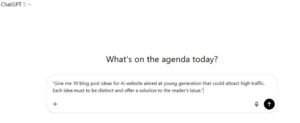
This can be used by freelance writers and content strategists to schedule the editorial calendar for their own blogs or to pitch article ideas to clients.
Proofreading and Polishing: “Proofread and enhance the following text for clarity, tone, and correctness: [paste text]. Make it sound professional and engaging, without changing the original meaning.”
Use this prompt to quickly edit client content or your own writing. It helps to create well-written content (essays, articles, and marketing copy) that clients are willing to pay for.
Social Media Marketing Prompts (Boost Engagement and Sales)
Digital marketers and creators can increase these prompts to produce social media content that drives engagement and even sales. From captions to content plans, let AI help you shine on every platform.
Social Media Content Calendar: “Plan a 2-week social media content calendar for a [type of business]. Give [platform of choice] 14 post ideas per day, each with a short theme or title and a goal (e.g., engage, educate, promote).”
Great for setting up your own posting schedule or providing social media planning as a service.
Instagram Captions Batch: “Write 5 Instagram post captions for a [niche/brand] promoting [product or theme]. Each caption should be one or two sentences, use an upbeat tone, include a couple of relevant emojis, and finish with 3 hashtags like #[keyword].”
Use this to quickly generate a month’s worth of IG content for a client.
Engaging captions = better reach and potential sales.
Twitter Thread for Expertise: “Write a 6-tweet Twitter thread about [“How to do X” or industry insight]. Start with a hook in the first tweet for quick attention. Each next of the tweet should add value or a step, and the last tweet quietly promotes [your product/service] or profile.”
Twitter (now X) threads help build power. This prompt lets you offer ghostwritten threads for founders or build your own following.
LinkedIn Thought Leadership Post: “Write a LinkedIn post (around 3 paragraphs) where a [professional role, e.g., marketing consultant] shares an idea: [brief key point]. Add a short personal anecdote or statistic, and end by asking a question to encourage comments.”
This type of post is great for LinkedIn content creation services because it gets attention and brings in clients.
Facebook Ad Copy: “Write a Facebook ad for [product/service] targeting [demographic]. Include a headline that grabs attention, two sentences showing the problem and how the product fixes it, and a call-to-action like ‘Learn More’.”
Freelancers can use this to make ad copy that gets good results for their clients.
TikTok Video Ideas: “Suggest 5 creative TikTok video ideas for promoting [product/service or topic] to [target audience]. Each idea should be short (15–30 sec), trendy (use popular music or challenges), and show an important benefit or feature.” Each idea should be short (15–30 sec), trendy (use popular music or challenges), and show an important or feature.”
This is helpful for social media managers who want to make viral videos that can boost sales.
Hashtag Strategy: “Give 10 effective hashtags for a [industry/niche] campaign on [Instagram/Twitter]. Use the mix of popular ones with niche hashtags, and explain in one line why each hashtag is useful.”
This helps social posts get seen by more people, which clients value when you handle their social media.
Influencer Outreach Message: “Write a friendly direct message to a micro-influencer (10k–50k followers) inviting asking them to work with [your brand]. Mention what you like about their content, explain how working together would help both of you, and offer to send them a free [product] to try.”
This is useful for businesses doing influencer marketing, and you can manage these messages with AI-made but personal notes.
Social media bio: “Write a catchy bio for a [platform, e.g., Instagram] profile for a [profession/business]. It should say what they do or offer, have a friendly call-to-action like (like ‘👇 Check our link’), and stay within the 150-character limit.”
This is great for freelancers who help improve profiles or for anyone building their personal brand online.
Engagement Questions/Post: “Give me 5 question-style post ideas to get more comments in Facebook group or page [for a specific niche]. Each question should be simple to answer and interesting to the community (e.g., ‘What’s your biggest challenge with X?’).”
This type of posts helps to start conversations, get more followers involved, and can lead to more sales later.
Digital Products & Online Income Prompts
Creators and business owners can use AI to develop digital products that earn money over time. These prompts help you create things like eBooks, online courses, printables, and more that you can sell on platforms like Gumroad, Etsy, or your own website.
eBook Outline and Draft: “Make a detailed outline for an eBook on a topic [topic, e.g., budget travel tips] for [target audience, e.g., young professionals]. Add 8-10 chapters with titles and a few bullet points of what each chapter include.”
This helps you quickly plan an eBook that you can write or have ChatGPT help write and sell as a digital download.
Online Course Curriculum: “Plan a course on a topic [course topic, e.g., Social Media Marketing 101]. Give a list of modules and lessons, each lesson will teach. Choose if it’s for beginner, intermediate, or advanced students.”
This helps you plan a paid online course or coaching program, and you can ask AI to add more details for each lesson later.
Printable Planner or Journal: “Create the content for a 30-day [theme, e.g., mindfulness] journal. Each day should have a unique quote, a question to reflect on, and a short tip about the themes.”
This is great for making journals, planners, or workbooks to sell on Etsy or other sites. ChatGPT can give you the daily entries, and you can put them into a PDF.
Checklist or Cheat-Sheet: “Make a step-by-step [checklist/guide] for [goal, e.g., launching a podcast]. The checklist should have at least 15 steps in right order, with a short explanatory sentence for each.”
People like checklists and cheat-sheets, and you can use them to grow your email list or sell as a low-cost product on Gumroad.
Merchandise Slogan Ideas: “Generate 10 funny and catchy slogan ideas for a T-shirt targeted for the specific audience [audience, e.g., cat lovers who code]. Each should be short (one line) and reflect both [themes, e.g., cats and coding humor].”
This is great for print-on-demand products like shirts, mugs, or stickers. Creative slogans can become designs that sell on sites like Redbubble or Teespring.
Educational Worksheet: “Make a one-page worksheet to teach [subject, e.g., basic budgeting] to [audience, e.g., high school students]. It should have a short explanation, a simple exercise or quiz, and 3 tips to remember.”
Teachers and edupreneurs can sell worksheet bundles on sites like TeachersPayTeachers. AI can quickly help write the content.
Digital Art Description for Sale: “Think of a digital art series on a theme (like futuristic cities). Describe 3 different art piece ideas in detail (visual elements, mood, colors) that could be sold as prints or NFTs.”
Artists can use this to get new ideas and then use AI to make and sell the artwork online.
Prompt Pack for Others: “Make a list of 20 ChatGPT prompt ideas that a type of professional [e.g., real estate agents] could use for their business.”
Believe it or not, prompt packs can be sold as digital products digital product! People create prompt lists for specific audiences and sell them on sites like Gumroad and PromptBase.You can do this too by asking ChatGPT for ideas and then improving and organizing them.
Social Media Content Bundle: “Generate 15 engaging social media post ideas for [business type, e.g., a local bakery]. Include a mix of promotion, behind-the-scenes stories, and customer engagement questions.”
You can sell ready-made content bundles to small businesses (like “30 days of social posts for your shop”). This prompt gives you the base ideas to package and sell.
Children’s Story or Book: “Write a charming short story for children (age 5-7) about a main character who solves a problem or learns something important. Use simple words and add a moral at the end.”
Kids’ eBooks and bedtime story collections are popular digital products on Amazon Kindle and other sites. You can make stories with AI and add pictures to create a book to sell.
Business Consulting and Service Prompts
If you do consulting, coaching, or run your own business, these prompts can help you earn money with ChatGPT. They make it easy to create analysis, plans, and professional documents very fast. You can use them to support clients or to improve your own business strategy.
Business Idea Brainstorm: “List 10 innovative business ideas in the [industry, e.g., eco-friendly products] space that could really make money. Add one-line how each idea would generate revenue.” Consultants or business owners can use AI as a brainstorming partner to discover the next money-making ideas.
Simple Business Plan Outline: “Make one-page business plan for a [type of business]. Include sections for: Value Proposition, Target Market, Revenue Streams, Marketing Strategy, and Startup Costs.” This is useful for quickly creating plans to guide a new business or to show a client a business overview. You can add more details to each section later.
SWOT Analysis: “Do a SWOT analysis for a [business type, e.g., freelance graphic designer]. Give 3 strengths, 3 weaknesses, 3 opportunities, and 3 threats in that context.” This helps Consultants or business owners to quickly build a strategy without having to start from zero.
Marketing Plan Draft: “Write a short marketing plan for [business/brand] launching [product/service]. Also include the target audience, main marketing channels (social media, email, etc.), a key message, and a 3-month action plan with bullet points.” This prompt gives a clear marketing strategy overview that consultants can share with clients.
Competitor Analysis: “List 5 main competitors in the [industry] for [company or product]. For each one, give one strength and one weakness (especially from a customer’s view).” This saves time on research and gives a quick look at the competition which helps businesses improve their strategies.
Customer Persona Creation: “Create an ideal customer profile for a [business type]. Include: Name, age, occupation, interests, main pain points linked to [the problem your business solves], and what they look when choosing a solution.” This helps consultants and businesses to understand their target audience and improve marketing.
Elevator Pitch: “Write a 30-second pitch for a [startup/business] that [solves X problem] for [target audience]. Make it exciting and clear, end with what makes this unique.” This helps entrepreneurs can practice their pitch and give consultants a quick tool to prepare the clients for investors or networking.
Sales Pitch Email: “Write a professional cold email to pitch [your service or product] to [target client, e.g., a local restaurant owner]. Keep it short: introduce yourself, share one big benefit or result you can offer, and invite them to a call or demo. Use a friendly tone.” This helps freelancers and consultants create mails that can win new clients when personalized.
Project Proposal Template: “Write a consulting project proposal for [service, e.g., improving a website’s SEO] for [client type]. Include: an introduction, the client’s challenge, your proposed solution approach, deliverables, timeline, and pricing structure.” This gives you a solid proposal draft to win new contracts.
Pricing Strategy Advice: “ give a basic pricing strategy for a [type of business, e.g., online coaching] that covers: what to charge (packages or hourly), how to give discounts or bundles, and how to explain the value to support the price.” This helps small business owners and consultants set prices that can boost profits.
YouTube Content Prompts(Creators and Video Freelancers)
Video material is a great income earner online. The prompts helps YouTubers (or video scriptwriting freelancers) in coming up with ideas, scripts, and optimization aspects that bring visitors and profits.
Video Script (How-To): “Write a warm, 5-minute YouTube script teaching [how to do something or a popular topic].start with a short intro hooking the viewer, followed by step-by-step points with concise examples. Close the script with a summary and call-to-action to like and subscribe.” You can use this to create your own video content or provide scriptwriting to YouTubers.
List of Video Ideas: “Give me 10 YouTube video ideas for a channel about [topic, e.g., personal finance]. Mix in different styles (tutorial, top 5 list, storytime, review) and make sure that each idea is likely to interest [target audience, e.g., young professionals wanting to save money].” Use this content ideas for your channel or to suggest topics if you’re managing content for someone else.
SEO Keywords for Video: “Suggest 5 top YouTube search keywords for, and suggest a catchy title for a video on [topic] incorporating one of those keywords.” Search optimization is the key to success on YouTube. This helps you make titles that get more views ( and ad more revenue) and it is also the service that you can offer to clients.
Video Description Template: “Write a YouTube video description for a video on [topic]. In the first 2 lines, give the summary to catch viewers. Then add a few sentences with more details, plus 3 hashtags (e.g., #AI #makemoney). End with a call-to-action (subscribe or link to related product).” A good description can boost video SEO and engagement. and you can use this for your own videos or as a service for YouTubers.
Catchy Title Variations: “Suggest 5 catchy titles for a YouTube video on [subject, e.g., passive income concepts]. Keep them short and interesting so people want to click.” Titles are the key for clicks. Having the options will help you find the best one, and clients love seeing choices.
Product Review Video Script: “Write a script for an 8-minute YouTube review of [product/service]. Include: an intro about using the product, an overview of features, honest pros and cons, and who should use it and end with where to buy or a discount code.” Review videos can monetize via affiliate links or sponsorships. and this helps you or your clients create clear and trustworthy reviews.
Tutorial/Guide Video Outline: “Create an outline for a tutorial video on [task, e.g., editing photos on a smartphone]. Divide it into 5 parts: Introduction, Step 1., Step 2., (etc.), and Conclusion. Offer a quick description of what to include in each part.” This provides a definitive guide to shooting a tutorial. You can film to the outline yourself or offer it to a client as a video content strategy service.
Engaging Video Intro Hook: “Create one line opener for a video about [topic] that instantly grabs attention. Make it surprising or ask a strong question to hook the viewer in the first 5 seconds.” The first moments of a video are important. A strong hook keeps people watching and improves video success.
YouTube Shorts Ideas: “give 5 ideas for YouTube Shorts (15–60 sec vids) a [niche, e.g., travel hacks] channel might upload. Each must be easy to produce and provide an surprising quick tip.” Shorts help to grow subscribers and views fast, leading to more ad or sponsor income.
Content Schedule Plan: “Make a 1-month content plan for a new YouTube channel on [topic]. Include one video per week with its subject/title, and say what type it shall be (e.g., vlog, interview, tutorial) in order to maintain variety.” Posting regularly helps channels grow. A content calendar is also a great extra service for clients.
Conclusion and Call-to-Action
ChatGPT can be your creative business partner in reaching your revenue targets all it requires is a clever prompt and follow-through on your part.
You now have 50 AI prompt ideas at your fingertips – ready to assist you in making money with ChatGPT in writing, marketing, digital products, consulting, and content creation.
The most important thing is to act: select a couple of prompts that resonate with what you want to achieve and test them out today. Whether you’re writing a blog article, creating a course, or mapping out YouTube material, these prompts will save you time and generate high-quality work that engages readers, clients, or customers.
Call-to-Action: Don’t let this list gather dust on your screen – get to work! Challenge yourself to use at least one of these profit-generating AI prompts today and watch the outcome. If you found this useful, think about subscribing to DailyAIEarnings for additional tips.
Subscribers also get a bonus: a free Prompt Pack containing all these 50 prompts (and a few extras) in convenient copy-paste format.
Tap the potential of AI and begin earning with ChatGPT the world is your limit and only your initiative can prevail. Good luck prompting, and to your success! 🚀
If you’re just starting out and want to see practical ways people are already making money, check out my guides on 10 Profitable AI Side Hustles. This article give you real-world income ideas that pair perfectly with the prompts given above.